· skunxicat
On this page
Signals #4: Mapping the Terraform Module Ecosystem
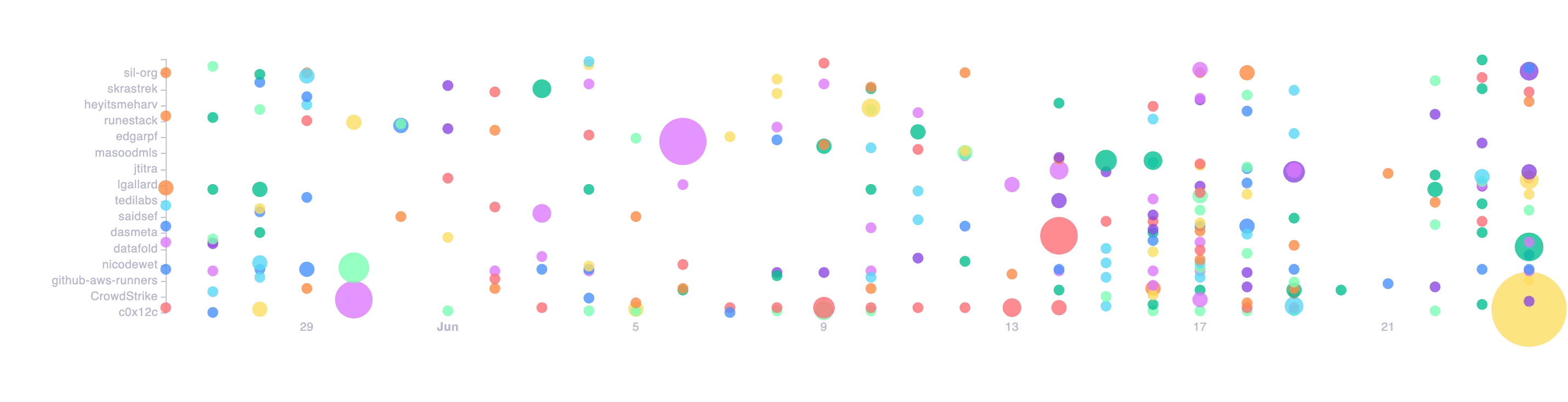
The Terraform Registry has thousands of AWS modules. Some are maintained. Most are abandoned. A few namespaces dominate. Which resources appear together? Which upstream modules get composed into new ones? Who ships continuously?
This signal crawls the entire registry, extracts structural metadata from source code, and produces datasets that answer these questions.
Datasets: Two JSON files served via CloudFront — one for all AWS modules, one for namespaces ranked by count.
The Registry API
Terraform’s registry exposes a paginated JSON API:
https://registry.terraform.io/v1/modules?limit=100&offset=0&provider=awsEach page returns up to 100 modules with metadata: namespace, name, version, downloads, source URL, publish date.
The Crawler
source scripts/fetch-modules.shFetch All Pages
fetch_modules () {
  local offset="${1:-0}"
  while :; do
    http_code=$(curl -sS -w '%{http_code}' -o "$OUTDIR/modules_${offset}.json" \
      "${BASE}?limit=${limit}&offset=${offset}&provider=aws")

    next=$(jq -r '.meta.next_offset // empty' "$OUTDIR/modules_${offset}.json")
    [[ "$http_code" == "429" ]] && echo "Rate limited, stopping." >&2 && break
    [[ -z "$next" ]] && break
    offset=$next
    sleep "$SLEEP"
  done
}
Handles rate limiting (429), pagination, and stores raw responses. Typically completes in 2-3 minutes for ~5000 modules.
Parse and Enrich
parse_modules () {
  cat "$OUTDIR"/*.json \
    | jq '.modules[]| . + {
      path: [.namespace, .name, .provider]|join("/"),
      registry_url: "https://registry.terraform.io/v1/modules/" + .namespace + "/" + .name + "/" + .provider,
      repo: .source|split("https://github.com/")|last
    }'
}
Adds computed fields: a canonical path, direct registry URL, and extracted GitHub repo path.
Namespace Ranking
parse_namespaces () {
  jq 'group_by(.namespace)[]| {
    namespace: first.namespace,
    url: "https://registry.terraform.io/modules/" + first.namespace,
    size: length
  }' | jq -sc 'sort_by(.size)|reverse'
}
Who publishes the most modules? CloudPosse, HashiCorp, a few others. Then a long tail of single-module namespaces.
Full Pipeline
update_datasetOne command: fetch → parse → rank → upload to S3.
Deep Metadata: Source Code Inspection
The registry index tells you what exists. To understand how modules are built, you need the source.
Filter Recent, Active Modules
fetch_subset /tmp/tf-aws-modules.json > /tmp/subset.jsonFilters modules published in the last 30 days with 100-1000 downloads — active but not the mega-popular ones everyone already knows.
Download and Inspect
generate_metadata /tmp/subset.jsonFor each module:
- Download the tagged release tarball from GitHub
- Run
terraform-config-inspect --jsonto extract structure - Produce JSONL with module calls, resources, and providers
curl -sL "$source/archive/refs/tags/$tag.tar.gz" | tar xz
terraform-config-inspect --json "$folder" > "$folder.json"
No git clone. No full repo. Just the tagged release, inspected, then deleted.
Output Schema
{
  "id": "schubergphilis/mcaf-cloudfront/aws",
  "published_at": "2025-06-01T...",
  "version": "4.0.1",
  "tag": "v4.0.1",
  "namespace": "schubergphilis",
  "downloads": 450,
  "modules": ["cloudposse/label/null", "..."],
  "resources": ["aws_cloudfront_distribution", "aws_waf_web_acl"],
  "namespaces": ["cloudposse", "hashicorp"],
  "providers": ["aws", "random"]
}
Every record tells you: this module uses these resources, calls these upstream modules, depends on these providers.
Questions This Answers
Who ships continuously?
jq 'group_by(.namespace)[]|{ns: first.namespace, count: length}' \
  | jq -s 'sort_by(.count)|reverse|.[0:20]'
Which resources appear together?
jq '[.resources[]]' /tmp/metadata.jsonl \
  | jq -s 'flatten|group_by(.)|map({resource: first, count: length})|sort_by(.count)|reverse'
Which modules are most reused?
jq '[.modules[]]' /tmp/metadata.jsonl \
  | jq -s 'flatten|group_by(.)|map({module: first, count: length})|sort_by(.count)|reverse'
Answer: cloudposse/label/null is in almost everything. Standard naming/tagging patterns propagate through the ecosystem.
Which providers beyond AWS?
jq '.providers[]' /tmp/metadata.jsonl | sort | uniq -c | sort -rnrandom, null, local, archive — utility providers show up everywhere alongside aws.
Grafana Dashboard
Upload datasets to S3, point Grafana Infinity datasource at your CloudFront URL:
your-domain/data/tf-aws-modules.jsonyour-domain/data/tf-aws-namespaces.json
Visualize:
- Module publish frequency over time
- Namespace activity heatmap
- Download distribution (long tail)
- Resource co-occurrence patterns
The Pattern
Registry API → Paginated Crawl → Parse + Enrich → Upload → Grafana
     ↓
Source Tarballs → terraform-config-inspect → Structural Metadata → Analysis
Two layers:
- Surface — what’s published, who publishes, when
- Deep — what’s inside, how they’re built, what they compose
Both produce static JSON datasets. Refresh when you’re curious.
Modules Used
| Tool | Purpose |
|---|---|
curl | Registry API + tarball downloads |
jq | JSON transformation at every stage |
terraform-config-inspect | HCL → JSON structural extraction |
upload_dataset (lib.sh) | S3 upload to datasets bucket |
| Grafana Infinity | Visualization |
Part 4 of the Signals series — small systems that observe larger systems.
Previous: Signals #3: GitHub Commit History as a Queryable Dataset | Next: Signals #5: Slicing CloudFront Logs