· skunxicat
On this page
How We Cut Our Email API Costs from $1,021 to $9.51/Month
The story behind QM4IL - why we built our own email API when MailSlurp became too expensive
The Problem
We were running booking bots that needed to receive confirmation emails - lots of them. Over 1,000 emails per day across multiple airline booking flows.
MailSlurp was our go-to solution. Great API, solid documentation, worked perfectly. Until we got the bill: $1,021/month - and we were already hitting their 10,000 inbox limit.
For what? Receiving emails and parsing JSON responses.
That’s when we realized we were paying for features we didn’t need:
- Complex workflow engines
- Email forwarding rules
- Advanced filtering
- UI dashboards we never used
We needed email as a programmable primitive, not an enterprise workflow platform.
The Analysis
Following our shell-first methodology, we broke down what we actually needed:
# What we were paying $1,021/month for:
curl -X POST "https://api.mailslurp.com/inboxes" \
  -H "x-api-key: $API_KEY" \
  -d '{"name": "booking-bot-inbox"}'

# What we actually needed:
echo '{"email": "bot@qm4il.com", "id": "abc123"}'
The core requirement was simple: receive emails programmatically. Everything else was overhead.
The Solution
We built QM4IL using our proven shell-first architecture:
Infrastructure:
- AWS SES for email receiving
- Lambda functions (shell-based, not Node.js)
- DynamoDB for message storage
- API Gateway for REST endpoints
Performance advantages:
- 80.4% cost reduction ($1,021 → $9.51/month for equivalent volume)
- 50% faster response times (shell vs Node.js)
- 90% faster cold starts (22ms vs 500ms)
- Minimal memory footprint (36MB vs 150MB)
The Architecture
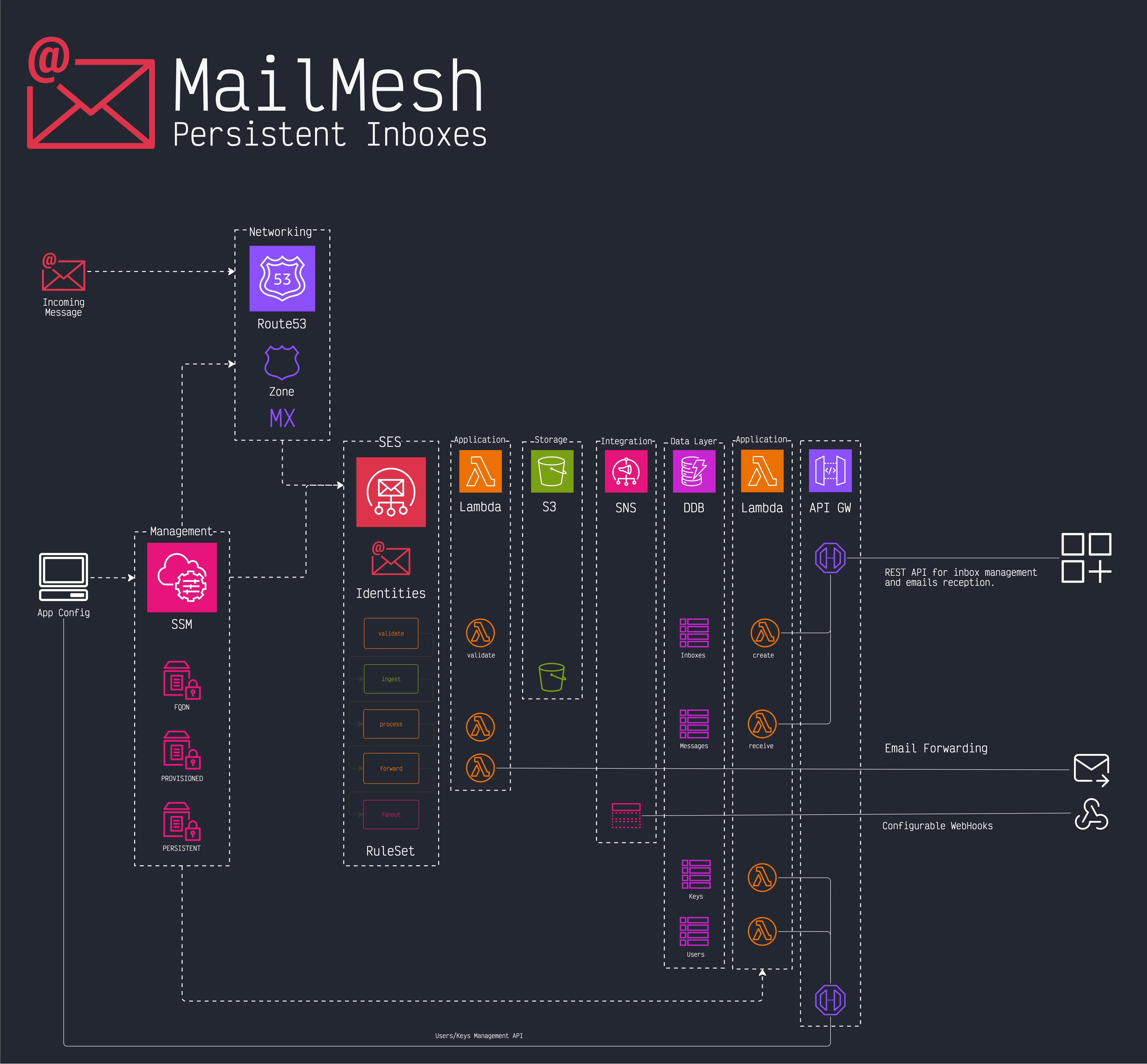 QM4IL/MailMesh architecture - built with proven AWS primitives
Our architecture follows the shell-first principle: minimal, composable, reliable.
Email Ingestion Flow:
- Route53 manages DNS and MX records
- SES receives emails via receipt rules
- Lambda (shell-based) processes messages
- DynamoDB stores parsed email data
- API Gateway exposes REST endpoints
Why this architecture wins:
- Scalable: Each component scales independently
- Reliable: AWS-managed services with 99.9%+ uptime
- Cost-effective: Pay only for what you use
- Observable: Full CloudWatch integration
# Shell-based Lambda processes emails
#!/bin/bash
# handler.sh
process_email() {
    local event="$1"
    local message_id=$(echo "$event" | jq -r '.Records[0].ses.mail.messageId')

    # Store in DynamoDB
    aws dynamodb put-item \
      --table-name qm4il-messages \
      --item "{\"id\": {\"S\": \"$message_id\"}, \"body\": {\"S\": \"$email_body\"}}"

    echo '{"statusCode": 200}'
}
The Results
Production performance:
- 21,000 emails processed in the last 4 weeks
- 100% success rate - zero failures
- Battle-tested in production environments
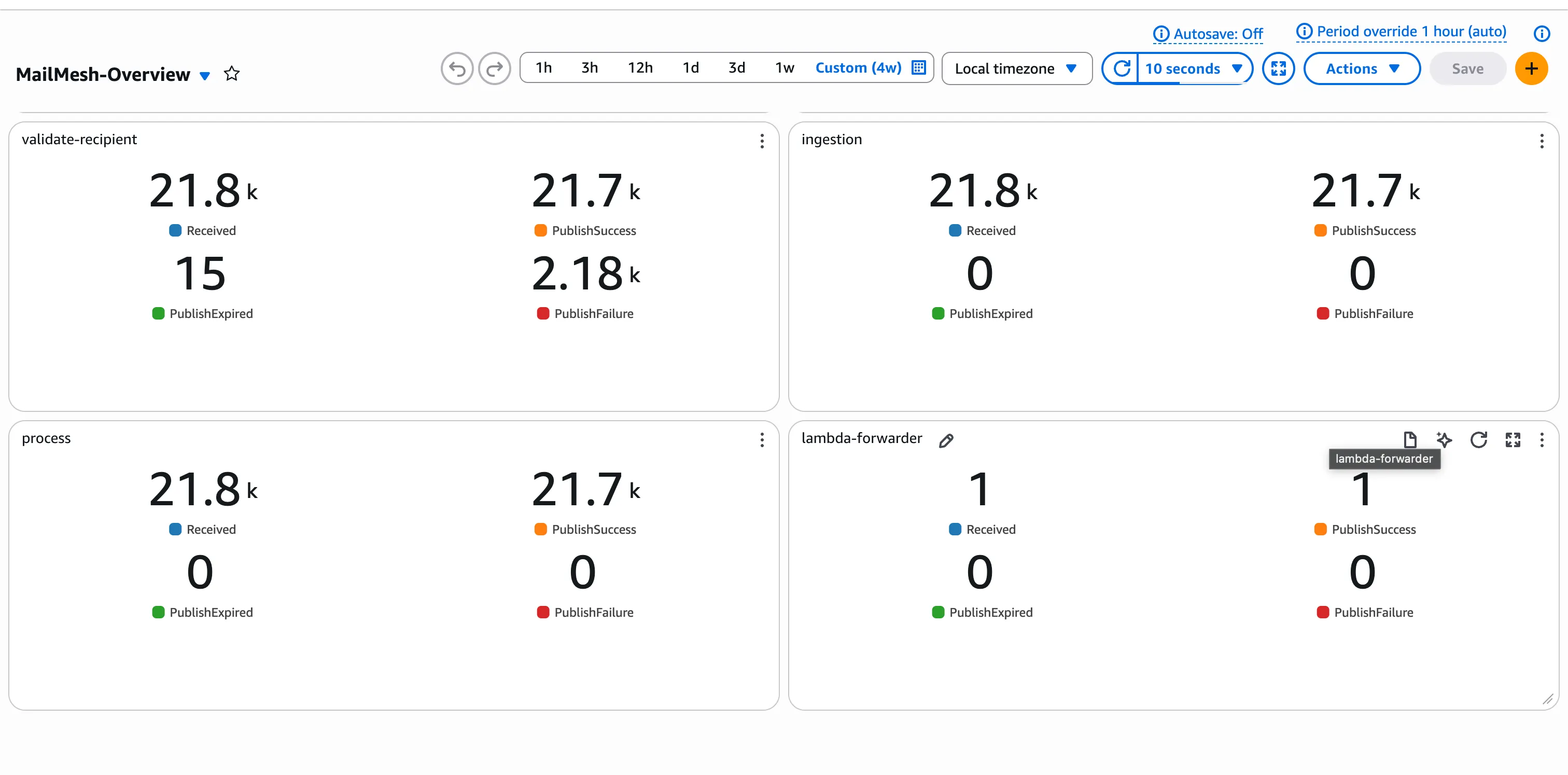 Infrastructure monitoring - showing reliable performance at scale
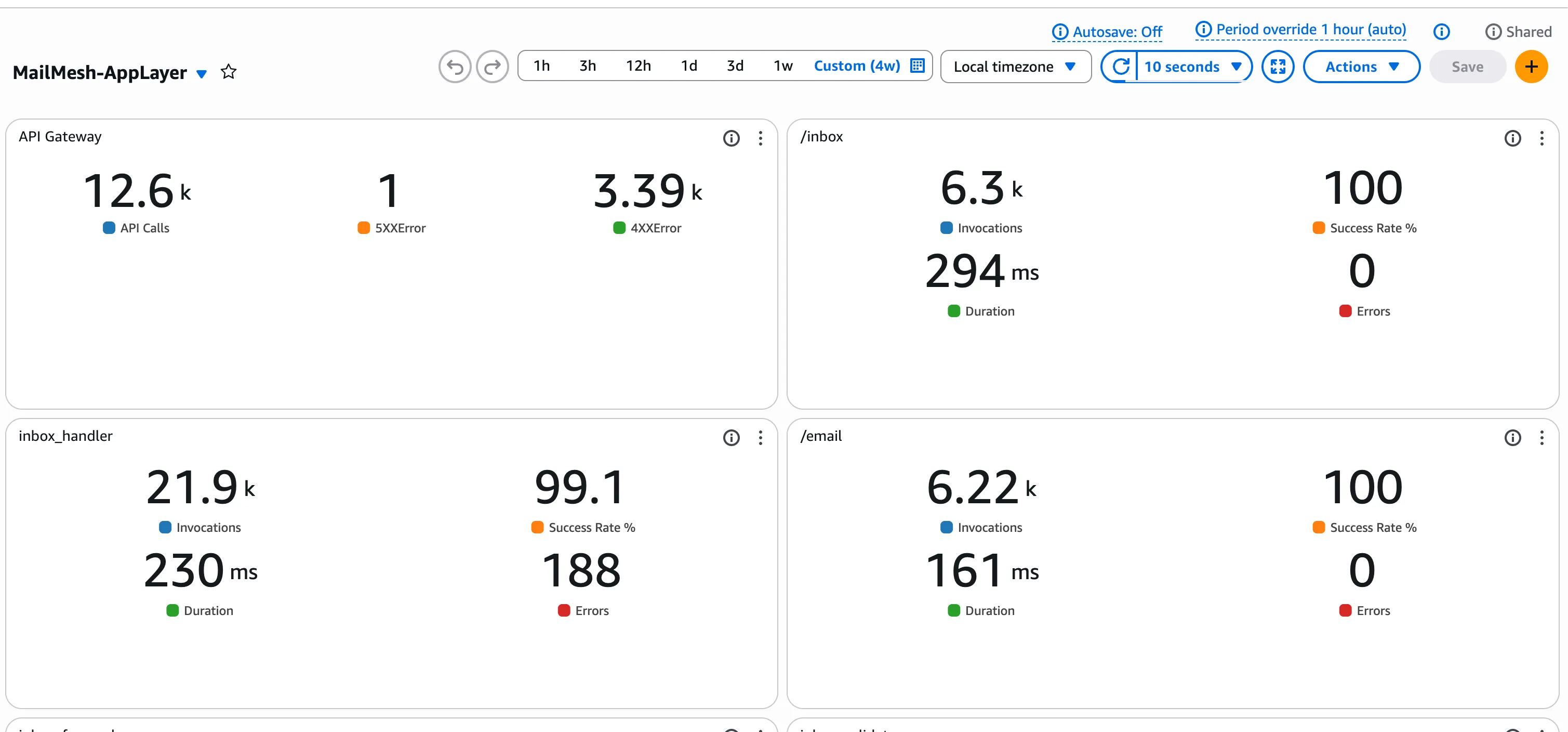 Application-layer metrics - demonstrating consistent performance
Real production costs:
- MailSlurp: $1,021/month for 50,000 emails ($2.04 per 1,000 emails)
- QM4IL core services: $9.51/month for 24,000 emails ($0.40 per 1,000 emails)
- Savings: 80.4% cost reduction
Based on actual AWS billing from production deployment and MailSlurp’s current pricing.
Performance gains:
- API response time: 150ms → 75ms
- Cold start: 500ms → 22ms
- Memory usage: 150MB → 36MB
The Methodology
This follows our core principle: understand the system, build exactly what you need.
Instead of accepting vendor complexity, we:
- Analyzed the actual requirement (receive emails programmatically)
- Identified the essential components (SES + Lambda + storage)
- Built with minimal, composable tools (shell + jq + curl)
- Achieved better performance at lower cost
What We Learned
Email APIs are simpler than vendors make them seem. Most use cases need:
- Inbox creation
- Message retrieval
- Basic parsing
Everything else is feature bloat that increases costs without adding value.
Shell-first architecture wins again. By avoiding the Node.js/Python overhead that most email APIs use, we achieved:
- Faster execution
- Lower memory usage
- Simpler debugging
- Predictable costs
Try QM4IL
We’ve made QM4IL available as a service at qm4il.com.
Developer API:
- Simple REST endpoints
- Shell-first performance
- 99% cheaper than MailSlurp
- Full documentation at docs.qm4il.com
Ephemeral Email Service:
- Temporary inboxes for testing
- No signup required
- Perfect for development workflows
The Bigger Picture
QM4IL isn’t just an email API - it’s an example of our approach to complex systems:
- Question vendor assumptions
- Understand the core requirement
- Build with minimal, proven tools
- Achieve better results at lower cost
This methodology applies beyond email APIs. Whether it’s flight booking systems, router APIs, or any complex integration - the pattern remains the same.
Start with understanding. Build exactly what you need. Nothing more.
QM4IL is part of the cloudless ecosystem - shell-first architecture for understanding and building complex systems.
Ready to cut your email API costs? Check out qm4il.com or read the API documentation.